Use it 1 season. Carry the costs and care all year.
The Short Version
You are not being asked to trust a slogan. You are being asked to read a structure: who holds the title, who
keeps the books, who is licensed, and what happens to your share when you want out or when you are gone.
Seasonal co-ownership is optional. The trust and the financial planning around it stand on
their own. Share a place with 4 other owners, or keep a home entirely to yourself full-time — the same
structure protects the asset and the people who inherit it either way.
Three structures. One written agreement. Records every owner can read.
This page explains structure only. It is not an offer, and nothing here replaces
Philippine title registration, lender consent, taxes, succession law, or your own independent legal review.
What “Real Ownership” Means Here: an Estate Trust
Ownership is held through an estate trust named for the property address. This is a
long-established estate-planning instrument, not a novel product: trusts of this kind are used in the United States
and the United Kingdom, and the Philippines recognises express trusts by statute under its Civil Code
(Arts. 1440–1457).
Why it usually does not trigger a due-on-sale clause. For US-financed residential property, the
Garn–St Germain Act (12 U.S.C. §1701j-3) bars a lender from calling the loan when a borrower transfers
into an inter vivos trust in which the borrower stays a beneficiary and occupancy does not change.
So the core rule is simple:the person on the mortgage must be a beneficiary
of the trust, at minimum. Break that link and the protection above can break with it.
Your terms stay private. The trust’s internal wording generally does not have to be
recorded in the land registry. The registry records title; it does not publish the family arrangements behind it.
None of this is automatic, and jurisdictions differ. The Philippines is a civil-law
system that recognises trusts by statute rather than through English common law, and Garn–St Germain is a US
statute that does not bind a Philippine lender. Lender consent, your actual loan documents, tax treatment, and
Philippine succession rules all still apply. Confirm your own position with independent counsel in every country
that touches your purchase.
How Ownership Works — Three Structures
All three are real ownership. The difference is where your name sits.
OPTION A
Everyone on the title
Every owner’s name goes on the title. Simple — and the only option most agents and lawyers
can offer.
Foreigners can own a Philippine condo outright.
The problem: seasonal groups get messy. Dates to agree. Bills to chase. An owner who stops
paying. A sale that needs new title paperwork.
We settle all that up front. It is why most groups pick Option B.
OPTION B · DAST
The trust holds the title
The title goes to a trust, run through a company. You own shares of it.
Selling is a share transfer, not new title paperwork. Getting out takes days, not
months.
The company keeps the place running — repairs, staff, the savings fund — whoever is staying
that season.
OPTION C
A home you already own
Own a place by yourself, all year? It can go into the same trust, named for its address.
Then add the planning: who inherits it, how it passes to them, and your mortgage, insurance, and estate
papers all agreeing with each other.
You keep 100% of it, all year. What changes is what happens when you no longer
can look after it.
How a co-ownership group actually runs it
GRC managing co-owner (10%) — property management, maintenance call-outs, calendar
administration, local representation. The group may also engage an outside property-management company — or
not. Either way, it is the owners themselves who care about the asset, vote the budget, and make sure things are
fixed properly.
Smart-contract cost splitting — HOA dues, taxes, utilities, insurance, and maintenance are
allocated pro-rata to each share and settled on-ledger; every co-owner sees the same books.
Governance — co-owners vote on capital decisions in proportion to their shares; GRC
administers but does not control.
Liquidity — a co-owner may sell their stake; the incoming partner assumes the same
interest, season, and obligations. Tokenized record-keeping and 1% payment servicing are provided by our
mortgage-technology partner.
Off-season yield — by choice — owners may offer their unused weeks for lease to
vetted corporate cohorts; any net income is distributed per the co-ownership agreement. Owners who prefer to keep
their residence private simply do.
The DAST trust and the stewardship model behind Option B are explained in full — including why the structure
is legal on both sides of the border — at
globalrealtor4acause.com/dast-slsp.
Why This Is Not a Timeshare
A timeshare sells a depreciating right-to-use against somebody else’s title, with escalating fees and no exit.
Here every participant holds real ownership — directly on title, or as shares of the entity that holds the title.
The asset appreciates or depreciates for the owners themselves, costs are transparent and pro-rata, management is a
fellow co-owner with aligned equity, and each stake is freely sellable.
Why the Records Sit on a Public Ledger
Co-ownership generates records: who holds which share, who paid which assessment, when a season changed hands.
Those entries are written to the XRP Ledger (XRPL), a public blockchain. Every co-owner reads the
same books, and no single party can quietly revise the history after the fact.
On the regulatory question. In July 2023 a US federal court ruled in SEC v. Ripple Labs
that programmatic XRP sales on public exchanges were not securities transactions; the litigation ended in 2025.
Regulated financial institutions now build on the ledger. That settled history is why XRPL was chosen — it is a
publicly scrutinised network with a known legal record, not an untested one.
No regulator endorses, approves, or guarantees this program. A court ruling about XRP
sales is not approval of any co-ownership offering. The ledger record supports the paperwork; it does not replace
Philippine title registration, lender consent, taxes, succession law, or independent legal review.
The Corporate Ecosystem
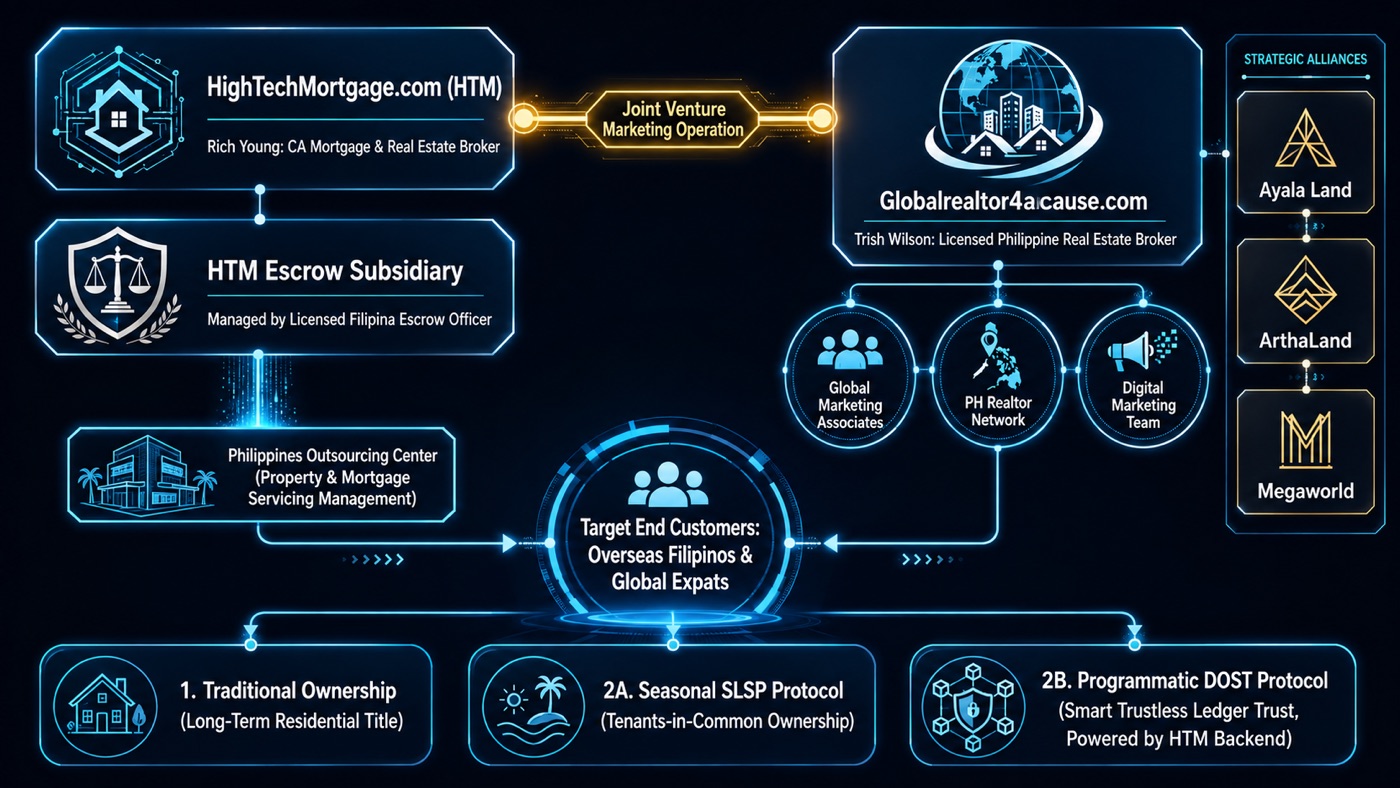
How the pieces fit: HighTechMortgage (US mortgage/escrow + smart-contract backend), Global Realtor 4 A Cause
(licensed Philippine brokerage and global marketing engine), developer alliances, and the three ownership pathways
offered to buyers.
XRPL LEDGER VAULT The programmatic pathway (2B) settles and
records on the XRP Ledger. The dashed outline marks the strategic marketing alliance wrapper.
The People Responsible
A structure is only as good as the licensed people standing behind it. These are theirs to lose.
Rich Young
Founder, President & Lead Broker
California DRE Broker #01106294
NMLS #291547
Bay Area mortgage and real estate veteran with a 30+ year career, now applying digital-economy tooling to
cross-border commercial real estate and mortgage infrastructure.
Trish Wilson
Real Estate, Finance & Philippine Operations
Licensed Realtor (US)
Philippine Real Estate Broker, PRC 0024025
Life Insurance Agent
Int’l Certified Financial Consultant
Blockchain Certified Agent
CPA (inactive)
Licensed in 2 countries as a real estate broker and financial planner, and a former Philippine CPA and
internal auditor at Philippine Airlines. BA Accounting, St. Paul University, Philippines.
She has advised businesses and investors on investment strategy, life insurance, estate planning, income tax,
asset protection, corporations, retirement plans, and immigration — and writes extensively for expats and
OFWs on real estate, finance, and taxes.
Dr Van Wilson
Data Science, AI & Smart Contracts
MIT post-grad program, AI & Data Science
AWS Certified Developer
Blockchain Training Alliance certified
Certified PostgreSQL / SQL Server / MySQL DBA
Microsoft Certified Trainer
Data scientist and DeFi smart-contract manager — he builds and runs the ledger side of the structure,
including the cost-splitting contracts and the ownership records.
35+ years in real estate, having personally owned and managed a $10M+ portfolio across 3 US states and
2 countries. BS, California State University, Fullerton.
Licences and certifications are held by the named individuals, not by any co-ownership
group. Verify any licence directly with the issuing regulator before you rely on it.
Looking for the Concept, Not the Structure?
The seasonal co-ownership idea itself — the seasons, the locations, what you actually own, and what it
protects your family from — is on the main page.
The view through the hero window is generated from the photograph “Lights Through The Mist”
(Benguet) by Jb Lardizabal, CC BY 3.0,
via Wikimedia Commons
— so the ridges, mist and hillside lights are the real ones.


.jpeg)